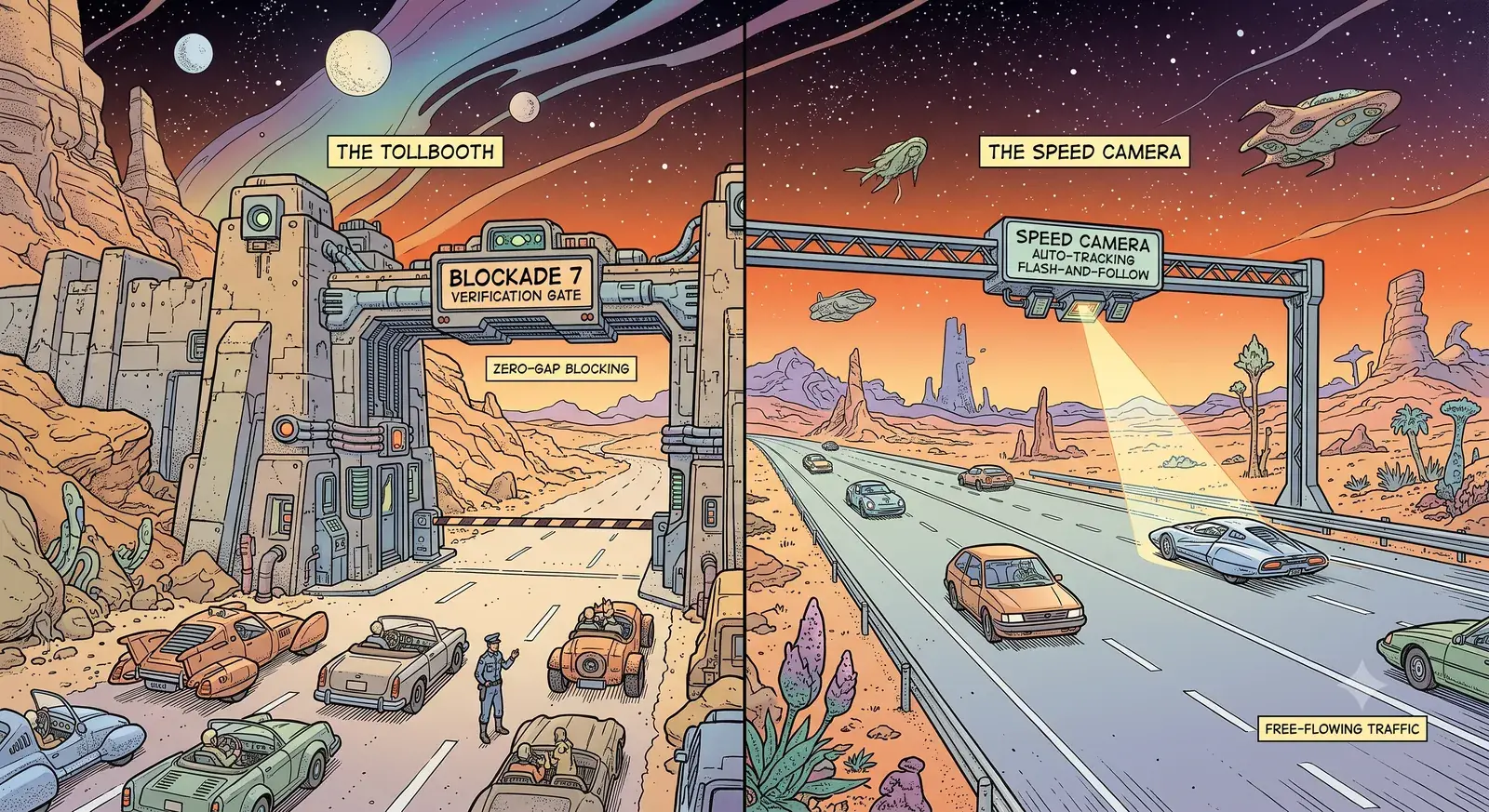
The speed vs quality dilemma
Last week I laid out one of the CI/CD (Continuous Integration & Continuous Delivery) engineer dilemmas: improve quality with more test coverage, or improve the speed of delivery. Brute-forcing both by throwing more machines at the problem works for a while, then stops working when the test suite runs for hours and rarely comes back green on the first try. But speed and quality don’t have to trade off against each other, and there are ways to speed up integration and delivery, while aiming for high quality.
Here I want to explore two of these (there are certainly many others out there!), heavily inspired by:
- How Continuous Integration is done at Google, explained in “Software Engineering at Google: Lessons Learned from Programming Over Time”, written by Titus Winters, Tom Manshreck and Hyrum Wright
- Some recommendations from the DORA program, which “seeks to understand the capabilities that drive software delivery and operations performance”.
- Some publicly available resources from the engineering blogs of Airbnb, Spotify and Uber.
Choosing one or the other, or even blending, depends on the environment you work in, and on what you value. But let’s dive in!
The gap between “true head” and “green head”
Every software change starts as merely written. There’s always some delay before the system can call it verified. Google calls the former “true head”, and the latter “green head”. When mapping that to a git setup, true head is the last change submitted, and green head is the one that has been validated against a suite of tests and meets the quality bar to be released.
To address our speed vs quality dilemma, an actionable question is: how wide do we let the gap between true and green heads be, and what do we do to close it? Let’s explore two possible answers for this question and how they fit different teams’ requirements.
Strategy A: Avoid the gap before it opens (confidence earlier)
The contract for this strategy is: nothing lands until tests are successful (this is the “green” state). There is no gap between the true and green heads, because the changes are verified before they land.
It’s the implementation of the “Not Rocket Science Rule of Software Engineering” rule coined by Graydon Hoare (the creator of Rust) and Ben Elliston: “Automatically maintain a repository of code that always passes all the tests.”
flowchart LR
    W["Change written"] --> D{{"On-demand checks
developer-triggered"}}
    D --> C1["Compile"]
    subgraph GATE["Merge gate (fail-fast ordering)"]
        direction LR
        C1 --> C2["Unit tests"] --> C3["Slow / edge-case tests"]
    end
    C3 -->|"all green"| L["Change lands
gap stays at zero"]
    GATE -->|"any step fails: cancel the rest, fix, resubmit"| W
A first testing checkpoint is developers running tests they deem relevant to validate their changes (or better: automate the tests running so that developers unfamiliar with the codebase and unaware of their blast radius don’t have to deal with the selection).
But the actual gate is coming when the changes are marked ready to land by the developer. The system must then run all stable tests against the changes and allow or block the landing.
This strategy ensures a certain level of quality (as good as your tests and coverage) at all times because all tests are successful before anything reaches the main branch and is made available to customers, or even internally. This builds confidence early in the integration and deployment process, and it’s simpler to reason about than the second strategy below.
What “never break the tip” costs as you grow
Keeping the true and green heads perfectly pinned together gets more expensive as commit volume rises, because tests have to queue.
As Titus Winters (ex-Google) puts it:
“Having a 100% green rate on CI, just like having 100% uptime for a production service, is awfully expensive. If that is actually your goal, one of the biggest problems is going to be a race condition between testing and submission.”
Flaky tests may cause a lot of reruns, and there may not be enough testing devices to accommodate the flow of changes coming every day, hour, minute.
So is this the right strategy for your team?
One way to find out is listing all the attributes of your current environment, your constraints and your requirements:
- How many developers are in your team? How frequently do they commit changes? Do you anticipate a lot of growth soon?
- If your team is relatively small this strategy could be acceptable as the finite resources will not be in constant high demand.
- Be aware this may become challenging entering an era where more and more AI agents contribute, which will increase the volume of changes by some orders of magnitude, even with a relatively flat number of human contributions.
- What is your blast radius per change?
- If your changes are scoped and tests are scoped to changes, this strategy could be acceptable as the number of tests per change will be limited.
- What are the regulatory and compliance constraints?
- If you require 100% green tests rate, such as for anything related to healthcare or critical product or services, it’s sometimes required to build maximal confidence early on. It is less important for not-so-critical services.
- Finally, do you have rollback and monitoring maturity?
- As we will see down below, if you don’t have the ability to catch issues fast after a change has landed, stick with strategy 1 and avoiding discrepancies between true and green heads.
If you don’t recognise your team reading these lines just yet, don’t worry. Let’s explore a second strategy.
Strategy B: Let the gap trail and chase it down fast (confidence later)
This is the test automation model Google describes in the Continuous Integration chapter (written by Rachel Tannenbaum) of their SWE book. At the time of book writing in 2020, this strategy allowed them to run an impressive 4 billion tests, against 50 thousand changes per day.
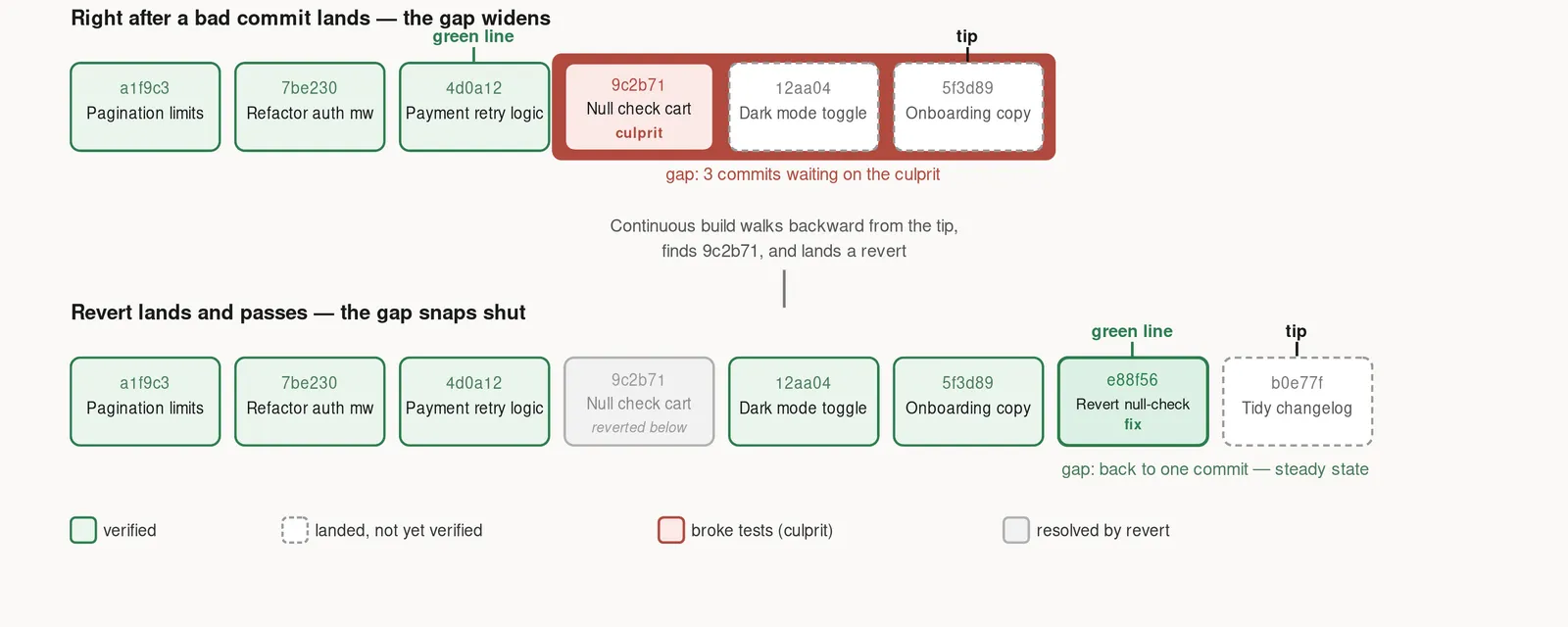
In this model the true head moves the instant something is submitted and the green head is wherever the test suite (Continuous Build, “CB” at Google) has finished verifying.
Only fast, reliable tests run before changes land (on presubmit). Think of linter, static analysis, smoke tests, basic compilation and build checks, if possible. The goal is to flag possible issues to the developers early, not to provide complete coverage.
After landing, on postsubmit, a more complete test suite kicks in. What happens when a test fails? A bisection modeled on git bisect runs against all the change commits to automatically find the culprit, which is then reverted to allow the rest of the changes to land.
Requirements and limits
Sometimes though, finding the one culprit is not possible. This should be accounted for when designing the system, especially at scale. Changes could be entangled, or flaky tests could point to the wrong culprit. In such cases, rather than pointing at one culprit it could make sense to rank suspects, or to revert a whole range of changes at once.
This works if reverting a change isn’t treated as an accusation, a cultural pre-requisite to this kind of “late” confidence system. Reverting must be cheap and blameless, and the fault must be attributed to the environment rather than the author.
Some more complex CI systems such as Uber’s SubmitQueue embed conflict analysers that prevent entanglement in the first place, at the submit phase.
A related requirement of this system is not to treat test failures as incidents, but to accept them as part of the system. Robust, reliable and possibly automated workflows must be built to handle reverting and tracking broken changes, bug hotlists and measuring how long cleanup takes.
Shifting more errors left: monitoring and alerting
Monitoring and alerting serve the same purpose as CI, according to Titus Winters: “to identify problems as quickly as reasonably possible”.
Charity Majors makes a similar point in “Testing in Production: Why You Should Never Stop Doing It”, arguing that no testing or staging environment can replicate production 100%. Design for that to make your infrastructure anti-fragile. Because failures will happen in production eventually, the question is whether you are able to catch them early before they impact your customers, and whether you’re able to act on them. Monitoring in production is one way to improve in this area, by building awareness.
Monitoring and alerting don’t replace testing, but mature teams should invest in both, especially with this CI strategy. That investment usually pairs well with improving other DORA capabilities, like fast and reliable rollbacks whenever alerts fire from production.
Is this the right call for your team?
Use the same list of requirements and constraints as for the first strategy, and evaluate them against each other:
- Do you have a high commit volume?
- Do you have a mature rollback and automated culprit-finding infrastructure? (or are you ready to invest into building one?)
- Do you have strong production monitoring capabilities?
- Do you have an engineering culture that can tolerate the green head being briefly behind the true head without feeling like an incident?
If you answered yes to most of these questions, “Chasing failures fast” would be a good, scalable strategy.
Tools and incentives to keep CI efficient
Whatever the strategy, you need to measure and optimize the overall efficiency of the system. Some tips to speed up testing at any point of the pipeline:
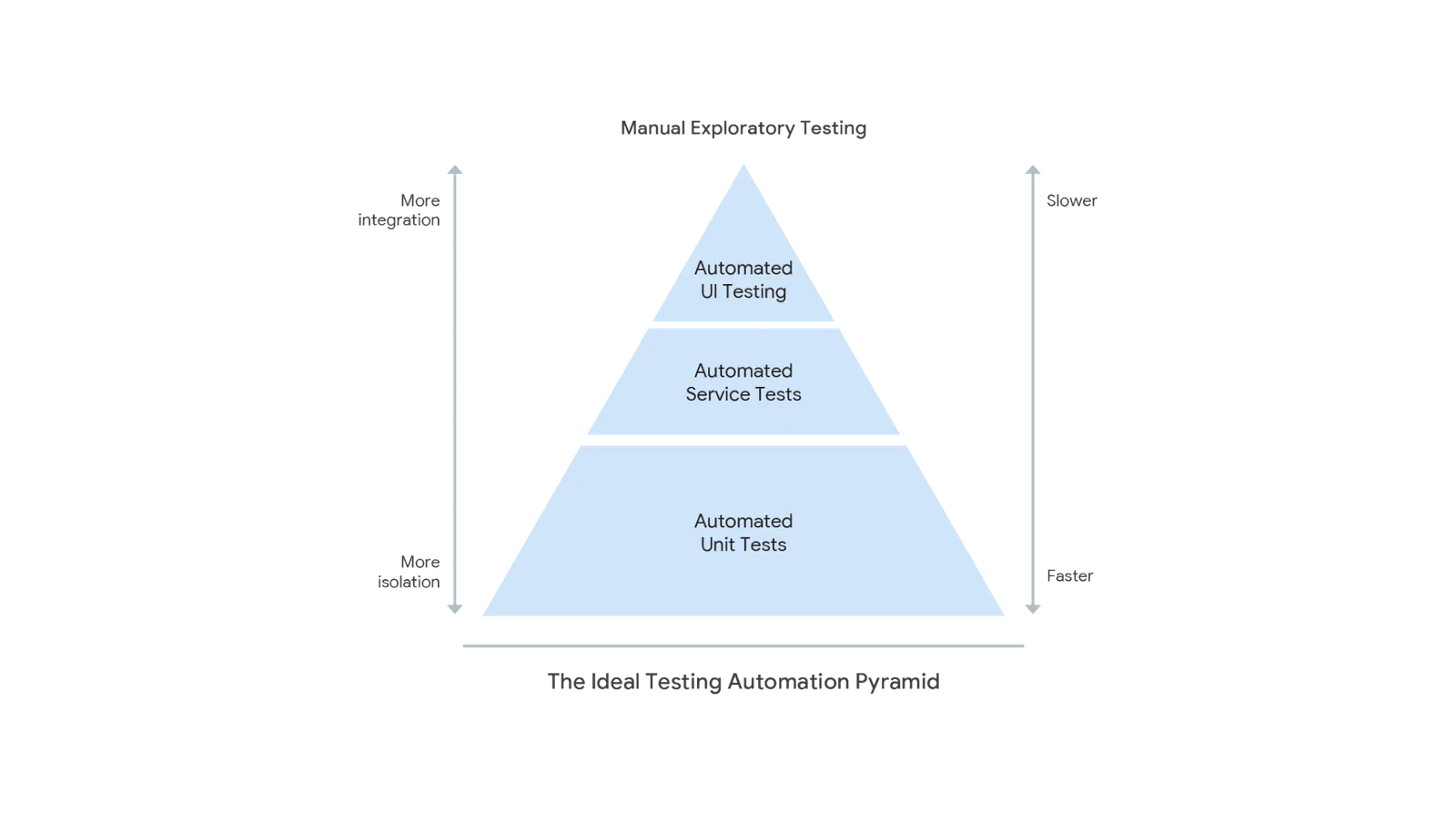
- As recommended by the DORA report on Test Automation, ordering the tests cheapest and most informative first, so an expensive job can be cancelled the moment a cheap one already failed (don’t run edge case integration tests on platform B before compilation for platform A was verified). Knowledge of the slowest test dependency chains in your system, as well as following the test pyramid guidelines make it easy to know how to order tests:
- Another recommendation from the DORA reports is to work in small batches (or in our context, with small changes). This needs to be paired with scoping tests to the changes. For example there’s no need to run UI tests on backend changes. There is an inherent benefit to that, according to Adam Bender from Google:
“The difference in waiting time between a change that triggers 100 tests and one that triggers 1,000 can be tens of minutes… engineers who want to spend less time waiting end up making smaller, targeted changes”
Final thoughts
There’s no one-size-fits-all CI strategy. The main question, “how far apart do you let written (true) and verified (green) heads drift?” is yours to answer, depending on your environment constraints and requirements. Do you prefer to build confidence very strictly and early in the process, or to allow some controlled detection and recovery mechanism?
Let’s also acknowledge that most of the teams and codebases start using Strategy A organically, and only pause to think about a possibly more complex strategy like B later on, when they hit scale limitations. This is perfectly fine.
Because importantly, choosing one or the other is neither a maturity ranking nor a binary choice: a team choosing zero-gap isn’t less advanced than one choosing trailing-gap. Furthermore, many teams blend strategies: zero-gap still needs some monitoring in production, and trailing gap needs some presubmit tests for early signaling.
One thing is sure: any mature strategy needs a reliable, strong underlying foundation: using git, trunk-based development and small changes. This discipline has been described again and again in the DORA reports, and is what unlocks landing changes quickly, reliably and continuously in an environment that’s easy to reason about.
Sources
- DORA report - Test Automation
- DORA report - Continuous Integration
- Google Testing blog - Efficacy Presubmit
- “Software Engineering at Google: Lessons Learned from Programming Over Time”
- Airbnb Engineering blog
- Uber Engineering blog.
The next part of this test automation series will land soon. Subscribe if you’d like it in your inbox.